


If you have a business in Dubai, you have probably seen that cyberattacks are happening all the time now. They are not unusual anymore. Ransomware gangs are getting more confident; phishing emails are getting harder to identify, and one unsecured Wi-Fi router can lead to a big breach. This is why many companies in Dubai trust an IT security audit in Dubai, and it has become something that you really need to have to survive.
Lots of people who own businesses think that antivirus software is all they need to stay safe. That is not true. Antivirus software can find things that it already knows about. It cannot fix a firewall that is not working right, an employee who uses the same password for everything, or a cloud storage bucket that is left open for anyone to see. There are threats from inside, like someone using the company wireless network in a way, and problems with cloud security that can be hidden until someone takes advantage of them. When that happens, it is too late to fix the problem without spending a lot of money.
What Is a Network Security Audit?
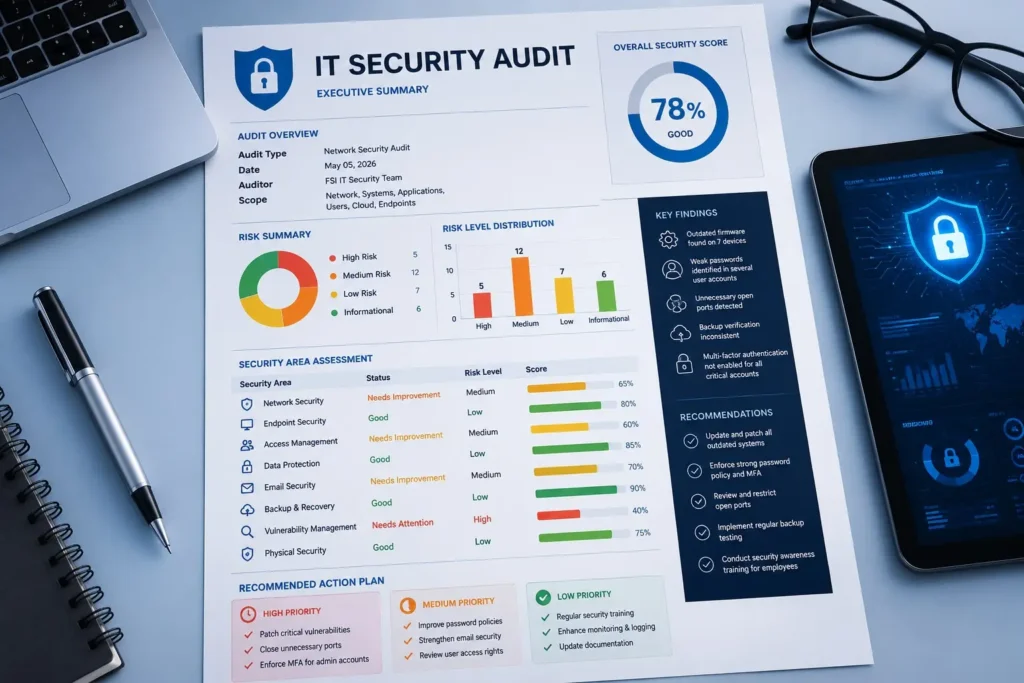
A network security audit is like a checkup of your IT system. Instead of guessing where your weaknesses are, a qualified team checks every part of your network and writes down what is strong, what is old, and what is not safe. They do this so you can see what needs to be fixed. A network security audit is something that Dubai companies trust to keep their IT environment safe.
A network security audit is very important for Dubai companies. It helps them find the weaknesses in their IT system. A network security audit checks every layer of your network. This includes your computers, your Wi-Fi routers, and your cloud storage buckets. The team doing the audit will tell you what is strong and what is weak. They will also tell you what you need to do to fix the parts. This way you can make your IT system safe and secure. A network security audit is something that every Dubai company needs to have.
A thorough network security audit in Dubai typically evaluates:
- Firewalls and their rule configurations
- Switches and routers
- Servers and the software running on them
- End-user devices (laptops, desktops, phones)
- Cloud infrastructure and storage
- User permissions and access levels
- Wireless networks and guest access points
The goal isn’t just to produce a report that sits in a drawer. It’s to give you a clear, prioritised action plan so you know exactly what to fix first.
Why Businesses in Dubai Should Conduct Regular Network Security Audits
Dubai’s business landscape moves fast, and so do the threats targeting it. Here’s why regular audits matter more than most companies realise.
Identify Hidden Security Vulnerabilities
Most breaches don’t happen because of some sophisticated hacking technique — they happen because of the boring stuff.
- Weak or reused passwords
- Open ports that were never closed
- Outdated software running unpatched
- Misconfigured firewalls with rules nobody remembers setting
An audit surfaces these issues before someone with bad intentions finds them first.
Protect Against Ransomware Attacks
Ransomware doesn’t just lock your files — it can bring an entire company to a standstill. Once attackers encrypt your data, you’re looking at:
- Costly file recovery (if recovery is even possible)
- Serious financial losses
- Days or weeks of business downtime
- Reputational damage with clients
A well-run IT security audit in Dubai businesses is scheduled regularly and helps close the gaps ransomware typically exploits long before an attack ever gets that far.
Improve Data Protection
Your firm is sitting on data that matters: customer records, financial information, and employee files. If that data isn’t properly protected, you’re one leak away from a serious legal and reputational headache.
Audits check whether you’re actually using:
- Proper encryption on sensitive files
- Role-based access control
- Secure storage practices
This is also where encryption solutions in Dubai businesses come into play. Encrypting data that is moving and data that is stored is one of the ways to reduce harm even if a breach happens.
Prevent Spam, Phishing and Email Threats
Email is still the number one way that attackers get into systems. Fake invoices, emails from CEOs asking for urgent money transfers, and attachments that have malware are all very common in Dubai’s business email traffic. An audit checks your email filtering. Shows where employees are most likely to be tricked.
Secure Mobile Devices
With smartphones, tablets, and remote work setups, your network now goes beyond the office. If a personal phone connects to company email without security, that is a weakness in someone’s pocket. Mobile device management and the ability to erase data remotely are essential in 2026.
Verify Your Backup Strategy
Here is a truth: many backups do not work properly. Businesses think they are safe until they need to get data back. Find out that the backup is broken, not complete, or has not run in weeks. An audit checks your backup and recovery process so you do not find out the hard way during a problem. This is a part of business continuity planning.
Ensure Antivirus Is Configured
Antivirus software is only useful if it is set up right. Outdated virus definitions, real-time protection that is turned off, or endpoint protection that is not used by everyone in the company can create problems. Reliable antivirus solutions Dubai companies need to be checked. Watched. Not just put in once and ignored.
Improve Employee Security Awareness
Even the best technical defences can be broken by one action. Human error is the main reason for security problems, which’s why security awareness training in Dubai is important. Including phishing tests, good password habits, and safe web browsing. Makes a big difference.
What Does a Professional Network Security Audit Include?
Here’s a quick breakdown of what a comprehensive audit typically covers:
| Security Area | What Is Checked |
| Firewall Security | Configuration, rules, firmware |
| Router & Switch Security | Access control, firmware updates |
| Wireless Security | Wi-Fi encryption, guest access |
| Server Security | Patch management, permissions |
| Endpoint Protection | Antivirus, malware detection |
| Backup Systems | Backup verification, disaster recovery |
| User Access | User privileges, MFA |
| Email Security | Spam filtering, phishing protection |
| Mobile Security | Device management, remote wipe |
| Network Monitoring | Logs, unusual traffic |
If your last audit didn’t cover most of this list, it probably wasn’t thorough enough. You can learn more about what a complete assessment looks like through IT System Security Dubai services designed specifically for this.
Warning Signs Your Business Needs a Network Security Audit
Not sure if it’s time? Watch out for these red flags:
- Slow or inconsistent network performance
- Frequent malware infections on company devices
- Suspicious or repeated login attempts
- Employees regularly receiving phishing emails
- Computers still running outdated operating systems
- Unknown or unauthorized devices connecting to the network
- Weak or inconsistent password policies
- Backup failures that go unnoticed for weeks
- Firewalls that haven’t been updated in a long time
- No formal cybersecurity policy in place
If even three or four of these sound familiar, it’s a strong signal that an audit shouldn’t wait.
Benefits of Choosing a Professional IT Support Company in Dubai
Handling all of this in-house is possible, but for most small and mid-sized firms, it’s simply not practical. A managed IT partner brings:
- Continuous network monitoring, not just occasional check-ins
- Preventive maintenance that catches problems early
- Help staying compliant with data protection requirements
- Ongoing network optimization
- A proper long-term cybersecurity strategy instead of reactive fixes
- Regular vulnerability assessments
- Dedicated IT AMC support for predictable, budgeted maintenance
Whether it’s ongoing IT Support Services in Dubai, structured IT AMC Dubai contracts, server and storage management, or broader network data security, working with an experienced IT outsourcing company Dubai businesses can rely on takes the guesswork out of protecting your infrastructure. It also means you get access to cybersecurity services Dubai teams that specialise in exactly this kind of proactive defence, rather than stretching your internal staff thin.
Best Practices to Improve Network Security
Alongside regular audits, these habits go a long way:
- Enable multi-factor authentication on every account that supports it
- Keep operating systems and software consistently updated
- Use strong, unique passwords across all systems
- Encrypt sensitive data both at rest and in transit
- Install and properly configure reliable antivirus software
- Train employees regularly, not just once during onboarding
- Perform and actually test regular backups
- Schedule periodic security audits instead of one-off assessments
For businesses wanting a broader perspective on network design and protection, resources like Networking solutions in Dubai offer useful context on building a more resilient infrastructure from the ground up. It’s also worth reviewing established frameworks such as the NIST Cybersecurity Framework, which many audit methodologies are built around.
Why Choose FSI Information Technology for Network Security Audits in Dubai?
There’s no shortage of IT vendors in Dubai, but not all of them approach security the same way. What tends to set a good partner apart:
- Experienced engineers who’ve actually handled real-world breaches, not just theoretical ones
- Comprehensive assessments that go beyond a basic checklist
- Proactive, round-the-clock monitoring rather than reactive troubleshooting
- Deep expertise in IT AMC support, so security and maintenance work together
- Customized solutions based on your industry and risk profile, not a one-size-fits-all package
- Fast response times when something does go wrong
- End-to-end support, from the initial audit to ongoing protection
If your firm hasn’t reviewed its IT Annual maintenance contract in Dubai arrangements recently, it’s worth checking whether security auditing is actually built into that agreement — many standard contracts leave it out entirely. You can also explore trusted IT AMC services as a reference point for what a solid maintenance-plus-security package should include and see the full scope of offerings through IT AMC Service in Dubai providers.
Conclusion
Cyber threats aren’t slowing down, and businesses that treat security as a one-time setup rather than an ongoing process are the ones most likely to get caught off guard. A network security audit doesn’t just tick a compliance box — it helps you find vulnerabilities before attackers do, protects the data your clients trust you with, and keeps costly downtime from derailing your operations.
If it’s been a while since your last review, now’s a good time to change that. Building regular audits into your long-term IT strategy isn’t overkill; it’s just good business.
FAQ
It’s a structured review of your entire IT environment — firewalls, servers, devices, and user access — to find vulnerabilities before they’re exploited.
Most experts recommend at least once a year, though businesses handling sensitive data or operating in regulated industries should consider auditing every six months.
No. Antivirus only catches known threats. An audit checks configuration issues, network gaps, and human factors that antivirus alone can’t detect.
It depends on the size of the network, but most audits for small to mid-sized firms take a few days to two weeks.
A vulnerability assessment focuses on finding specific weaknesses, while a full audit looks at your entire security posture, including policies, backups, and employee practices.
It can significantly reduce the risk by identifying and closing the gaps ransomware typically exploits, though no single measure guarantees complete protection.
Small businesses are often bigger targets precisely because they tend to have weaker defences. Size doesn’t reduce the need , it just changes the scale of the audit.
You’ll receive a report outlining vulnerabilities, risk levels, and a prioritised action plan, usually along with recommendations for ongoing monitoring.
Since human error causes so many breaches, most audits include a review of staff awareness and may recommend phishing simulations or structured training.
For most small and mid-sized firms, outsourcing to an experienced IT outsourcing company Dubai businesses already trust is far more cost-effective than building an internal team from scratch.
